What Drives Restaurant Booth Cost per Linear Foot? A Buyer's Guide to Quotes
Why custom restaurant booths are quoted per linear foot, and the factors that move the number: back style, height, curves, upholstery, foam, freight and duties.
Short answer: Custom booths and banquettes are quoted per linear foot of seating because most of the labor and material scales with length. The biggest drivers of that figure are back height and style, curves and corners, the upholstery you choose, foam and frame specification, end and base details, and, for imported seating, freight volume and import duties. Comparing quotes line by line on these points tells you far more than comparing a single total.
We do not publish prices, because a meaningful number depends on your drawing. What we can do is explain exactly what moves it, so you can decide where to spend and where to save.
Why are booths priced by the linear foot?
A booth is mostly a repeating structure: a seat box, a back frame, foam and upholstery, all of which scale with length. Quoting per linear foot lets you compare runs of different lengths, and lets the supplier price fixed extras separately: end panels, corners, curves, power, storage.
A typical custom quote therefore reads like this:
- Base rate per linear foot for each booth or banquette style.
- Adders per linear foot for options that scale with length (higher back, tufting, a premium fabric).
- Fixed items per piece (end panels, corner units, curved sections, arm posts).
- Freight, packing and, depending on terms, duties and delivery.
What drives the cost of a booth?
| Driver | Lower cost | Higher cost | Why |
|---|---|---|---|
| Back height | 36 in | 48–60 in | More frame, foam and fabric per foot |
| Back style | Plain tight back | Channel, biscuit, deep diamond tufting | Sewing and stuffing labor |
| Plan shape | Straight runs | Curves, U-shapes, variable radius | Custom frames, foam cut to shape |
| Upholstery | Standard commercial vinyl | Leather, velvet, patterned fabric with repeat | Material cost and yield |
| Foam | Standard commercial density | Higher-density, fire-retardant specification | Material grade |
| Frame & base | Upholstered or laminate plinth | Solid timber, veneer, metal trims | Material and finishing |
| Ends & details | Square upholstered ends | Timber end panels, arms, brass trims, power | Fixed per-piece labor |
| Logistics | Compact sections, shared container | Oversized pieces, LCL only, DDP | Volume and service |
1. Back height
Every inch of back height adds frame, foam and fabric across the whole run. Going from a 36 in to a 48 in back increases the upholstered area of the back by roughly a third. Taller freestanding booths also need stronger floor fixings.
2. Back style and sewing labor
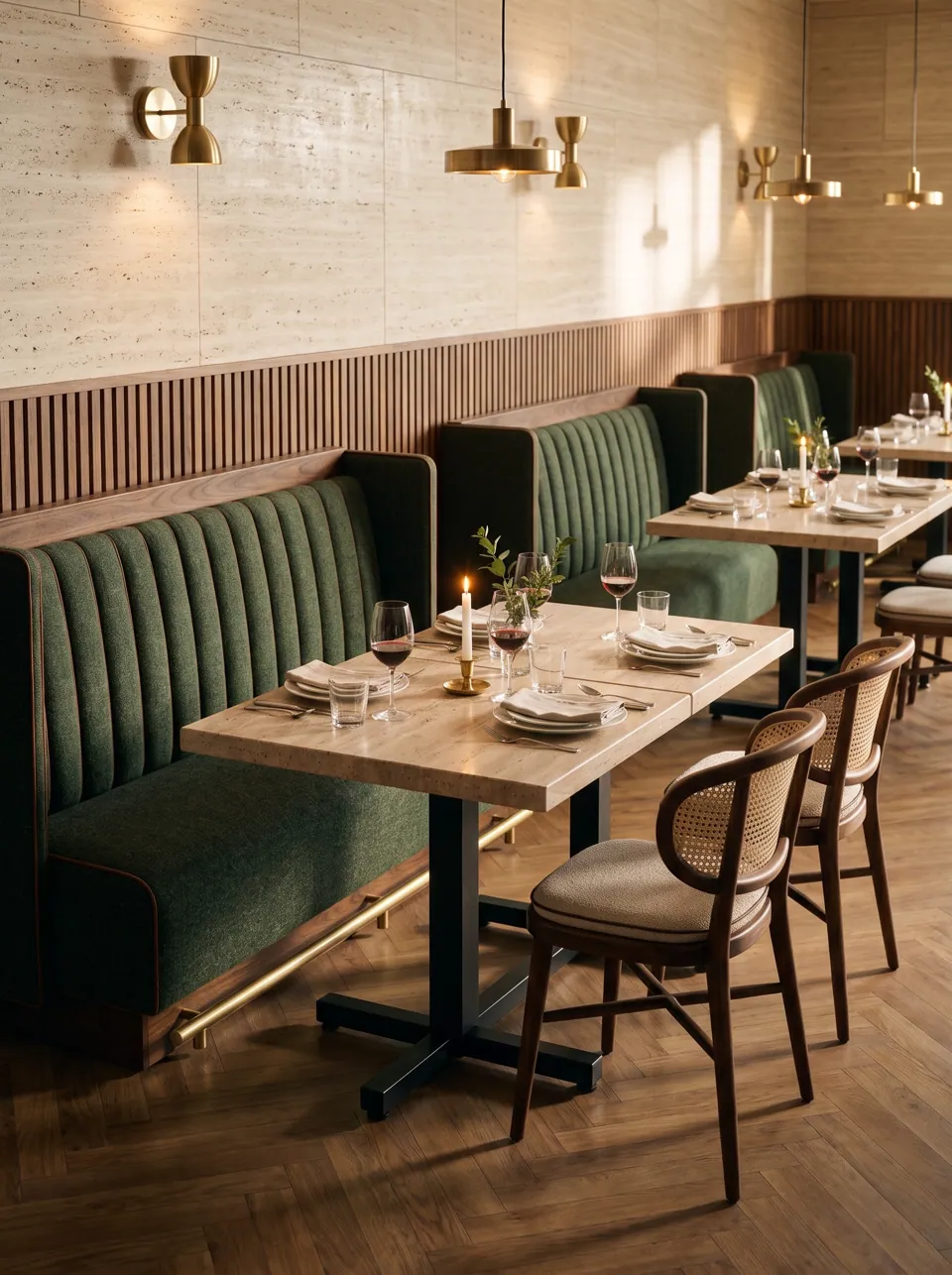
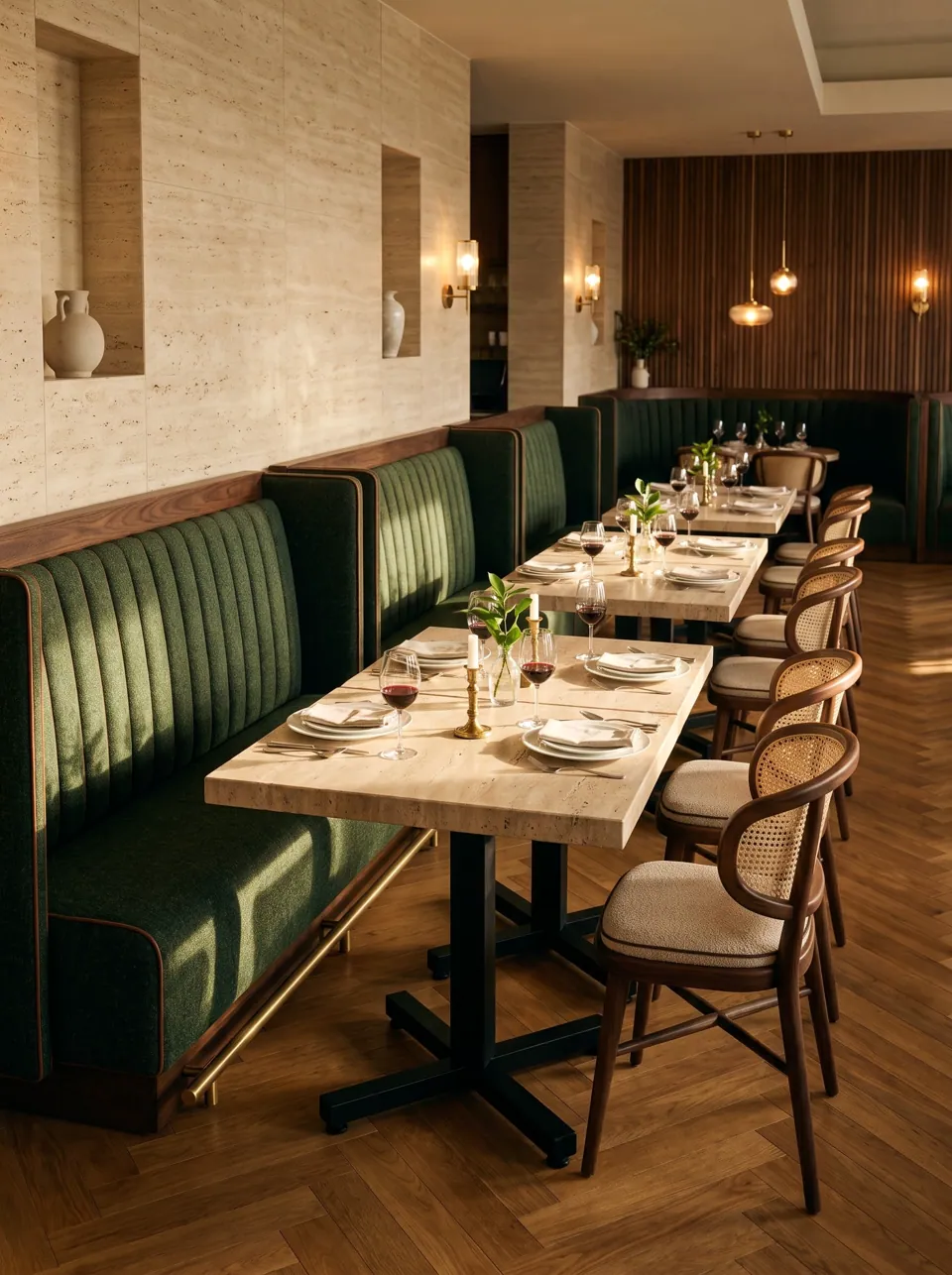
A plain back is quick to upholster. Vertical or horizontal channels mean individually stitched and filled tubes. Biscuit tufting adds a grid of stitched squares. Deep diamond button-tufting, the steakhouse look on our Prime Deep-Tufted Steakhouse Booth, is the most labor-intensive common back and uses noticeably more material, because the fabric is pulled into each diamond.
3. Curves and corners
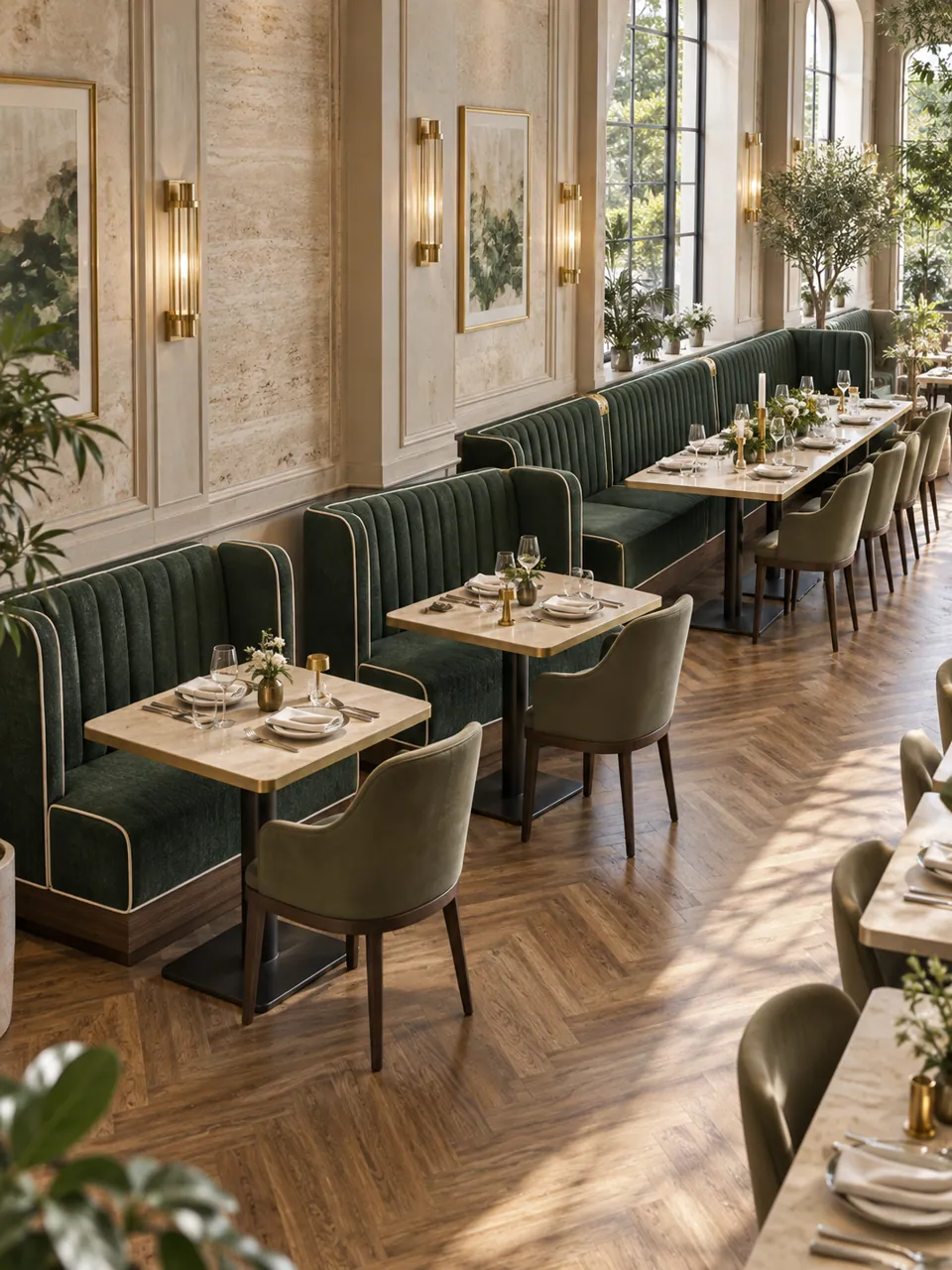
Curves are the single largest jump in cost per foot. A curved frame is built to a radius rather than cut from straight stock; foam is cut as fans; channels must stay evenly spaced on a curve; and trim has to be bent to follow. Corner units and variable-radius curves add drawing and setting-out time. Our Curved, Half-Round & U-Shaped Booths collection shows the range.
4. Upholstery
Upholstery choices affect cost in two ways: the price of the material itself, and how much of it you need. Patterned fabrics with a large repeat waste more material to match the pattern at every seam. Leather is sold by the hide and has natural flaws that must be cut around.
You can also supply your own material (COM or COL). That removes the material cost from our quote but not the labor, and the fabric must reach the factory before cutting begins.
5. Foam and fire specification
Commercial booths need firmer, higher-resilience foam than residential sofas. If your jurisdiction or specifier requires a particular fire performance, such as foams and covers specified to meet CAL TB 117-2013, the material grade changes and test documentation may be required. Specify this at the quote stage, not after.
6. Frame, base and ends
A rigid seat box is standard. Upgrades include solid timber end panels, veneered plinths, metal kick plates, brass or bronze trims, arm posts and built-in power. Each is usually priced per piece, because a 6 ft booth and a 12 ft booth both have two ends.
7. Freight volume
Booths are bulky, and sea freight is priced by volume. Two decisions make a large difference: splitting long runs into sections that pack efficiently, and shipping booths together with tables and chairs so the container is full. Mixed-SKU container loads are welcome on our side.
8. Duties, tariffs and delivery terms
Imported furniture is subject to US customs duties, and furniture made in China may face additional tariffs. Rates change, so ask your customs broker to confirm the current classification and rate at the time of shipment. Your incoterm decides who handles what:
- FOB: we deliver to the port in China; you arrange freight, customs and delivery.
- CIF: we arrange freight and insurance to your destination port; you handle customs and delivery.
- DDP: we arrange delivery to your door with duties paid, quoted as an all-in figure.
How to compare booth quotes
- Normalize to linear feet. Ask every supplier to quote per linear foot for each style, with fixed items listed separately.
- Check the back height and depth. A quote for a 36 in back is not comparable with one for 42 in.
- Check the upholstery grade. Ask for the abrasion rating (double rubs) and fire specification of the quoted material.
- Check foam and frame. Ask what the seat foam is, what the frame is made of and how sections join.
- Check what is included. Shop drawings, samples, packing, freight, duties, delivery and fixings can each be in or out.
- Check the lead time basis. Is it from deposit, or from drawing approval? Ours is typically 30–45 days for standard designs and 45–60 days for custom work after approvals, plus transit, and confirmed in each quote.
- Check the tolerances. Will the supplier build to your measured wall, or to the nearest catalog length?
Where to save, and where not to
Good places to save: a plain or horizontal channel back instead of deep tufting; a 42 in back instead of 48 in where privacy is not critical; straight runs with a single curved feature booth rather than curves everywhere; upholstered or laminate plinths instead of solid timber.
Places not to save: seat foam and frame construction, which decide how the booth feels after two years; upholstery abrasion rating; and accurate measurement and drawings, which prevent the most expensive mistake of all, a booth that does not fit.
Common mistakes
- Comparing totals instead of specifications. The cheapest quote often has a lower back, thinner foam or a residential-grade fabric.
- Choosing fabric after the quote. A fabric change from vinyl to velvet can change the number significantly. Choose early.
- Ignoring freight volume. One oversized curved booth can push an order into a larger container.
- Forgetting duties. For imported seating, landed cost, not factory cost, is the real number. Get your broker's view early.
- Not budgeting for installation. Booths need fixing to walls and floors. Ask your contractor to price it at the same time.
FAQ
Why don't you publish booth prices?
Because a meaningful number depends on length, back height, style, upholstery and delivery terms. We quote every project from its drawing, per linear foot, with options listed separately.
Is COM cheaper than using your fabric?
It removes the fabric cost from our quote, but you pay your fabric supplier and the freight to our factory. It makes sense when you need a specific fabric or already have stock.
Do curved booths cost more?
Yes. Curves are among the largest cost drivers per foot because frames, foam and trims are built to a radius. A single curved feature booth often gives most of the visual effect for a fraction of the cost of curves everywhere.
What is included in a Banquette House quote?
Shop drawings for approval, the booths themselves, export packing, and the freight terms you ask for (FOB, CIF or DDP). Samples are available on request. Each quote lists exactly what is included.
How can I reduce freight cost?
Ship booths, tables and chairs together in one container, let us split long runs into efficiently packed sections, and confirm the delivery route early so sections are sized correctly the first time.
Send us your floor plan or wall dimensions and the number of covers you need. We will reply with a layout suggestion and a quote by the linear foot.
Request a quote